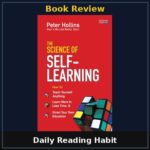
The Science of Self-Learning Book Review – Master Independent Learning by Peter Hollins
 BestPriceDeal.in
The Science of Self-Learning by Peter Hollins Review: Thinner Than the Title Suggests, and That’s Not Automatically Bad
Here’s something worth knowing before you buy: this book is genuinely short — four chapters, plus a summary guide. If you’re picturing a dense neuroscience deep-dive because of the title, recalibrate. This is closer to a tight, practical field guide than a textbook, and whether that’s a strength or a letdown depends entirely on what you came for.
What You’re Actually Getting
Peter Hollins is enormously prolific — this is literally book one in his “Learning How to Learn” series, which runs into a dozen very similarly-titled entries (The Science of Rapid Skill Acquisition, Accelerated Learning, and others that all circle the same territory). That’s worth knowing going in: some of what feels “familiar” if you’ve read adjacent self-improvement books isn’t déjà vu — it’s genuinely the same author covering overlapping ground across a large catalog.
The actual content here walks through how to break a topic into a self-designed syllabus, engage critically with new information rather than passively absorbing it, read faster without losing comprehension, and build habits that sustain independent learning over time. One nice specific touch: Hollins draws on Benjamin Franklin’s famously disciplined daily schedule as a model for structuring learning time — a concrete historical anchor rather than another generic “make a schedule” tip.
Where It Earns Its Keep
If your actual problem is “I don’t know how to teach myself something from zero,” this book answers that specific question directly and efficiently. It’s not padded with motivational filler, and real readers consistently describe it as fast, clear, and immediately usable — you could plausibly read it in an afternoon and start applying it the same day.
Where It’s Honestly Thin
The most common complaint from people who’ve actually read it is that it feels like it could have been a long article rather than a full book — and having gone through it, I’d agree that’s fair. If you’re expecting the kind of citation-heavy cognitive science grounding the title implies, you’ll find real techniques (like the SQ3R reading method) mentioned, but not explored with the depth “Science of…” promises. Treat the title as a hook, not a literal description of academic rigor.
Who Should Actually Buy This
- Someone who wants a fast, no-nonsense starting point for teaching themselves a new skill, without committing to a longer book.
- Readers who value brevity and directness over deep theoretical grounding.
- Anyone curious about self-directed learning who hasn’t read anything in this space yet — as a first book on the topic, it’s a reasonable entry point.
Who Should Skip It
- If you’ve already read one or two of Hollins’ other “Learning How to Learn” titles, expect real overlap rather than new material.
- If you want the neuroscience genuinely unpacked in depth, this stays at the surface — look elsewhere for that.
Verdict: 3.8/5
Solid and usable for what it actually is — a short, practical primer — but the title oversells the depth on offer, and its own author’s catalog is its biggest competitor. Good as a first read on self-directed learning; don’t expect it to be the last book you’ll need on the topic.
Buy The Science of Self-Learning here: GET DEAL — ₹291 (was ₹345)